Droppers and Hooks: How to Choose


How to Choose Hanging Wires and Picture Hooks
Choosing hanging wires and hooks starts with what you want to hang. A small photograph, a wide painting and a heavy mirror can all use a picture-rail system, but they will need different wire-and-hook combinations.
The main things to consider are:
- The weight of your artwork, including its frame and glass.
- How discreet you want the hanging wires to look.
- The fittings on the back of the frame.
- Whether you’ll use one or two hanging wires.
- How often you’re likely to rearrange your display.
Here’s how to put the pieces together.
Choose your hanging wire
Hanging wires are also called droppers, hangers or hanging cables. They connect the picture rail to the adjustable hooks supporting your artwork.
Perlon or steel?
Perlon is a clear nylon line. It’s a good choice when you want the artwork to get the attention and the hanging line to remain discreet.
Steel wire has a more visible, deliberate appearance. Some people prefer that modern architectural look, particularly in galleries, offices and contemporary interiors. In the 1 mm range, steel also offers a higher weight allowance than Perlon.
Both materials are available in our 1 mm Twister range and 2 mm Twister range.

What thickness do you need?
Choose the wire and hook together. The hook’s rating does not increase the capacity of the wire.
These common Twister and Micro Grip combinations provide a useful starting point:
| Hanging wire | Matching hook | Maximum per wire-and-hook combination |
|---|---|---|
| 1 mm Perlon Twister | Micro Grip 1 mm | 5 kg |
| 1 mm steel Twister | Micro Grip 1 mm | 10 kg |
| 2 mm Perlon Twister | Micro Grip 2 mm | 20 kg |
| 2 mm steel Twister | Micro Grip 2 mm | 20 kg |
These figures apply to the specified combinations. The installed rail, wall fixings and fittings on the artwork must also support the load.
What length should you choose?
Measure from the rail to the lowest position where you want a picture hook to sit. Allow enough length for the wire to pass through the hook.
If you’re hanging several pictures below one another, choose a wire long enough to reach the lowest hook. Spare wire can be concealed behind the artwork.
Choose how the wire attaches
The attachment head determines how you insert, remove and rearrange the hanging wire.
Twister: convenient for rearranging
An Artiteq Twister hanging wire can be inserted anywhere along the rail. Insert the head, turn it into position and check that it is properly seated.

You don’t need access to a rail end, making Twister particularly convenient for rails installed wall to wall and displays you like to change.
Twister Cliq2Fix: extra retention at the rail
The Artiteq Twister Cliq2Fix also inserts along the rail. Its locking head provides extra retention while allowing the wire to slide sideways.
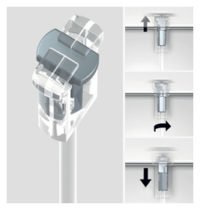
It’s worth considering for high walls and other places where reaching the rail again would be inconvenient.
Solid Slider: inserted from the rail end
The Artiteq Solid Slider feeds into the rail from an open end and then slides along it.
Check end access before choosing this option. If your rail runs wall to wall with no accessible opening, you won’t be able to feed a Solid Slider into it.

Loop-ended wire: for gallery hooks and other supports
For traditional timber picture rails, a loop-ended Perlon wire slips over an Artiteq gallery hook. The loop provides the upper attachment; adjustable picture hooks support the artwork farther down the line.

Choose your picture hook
The picture hook slides along the hanging wire to set the artwork’s height. Choose one that suits the wire diameter, artwork weight and frame fittings.

Artiteq Micro Grip: compact and self-locking
Micro Grip hooks grip the hanging wire automatically when released. They’re convenient when you want to adjust and level artwork without tightening a screw each time.
Choose:
- Micro Grip 1 mm for 1 mm Perlon or steel wires.
- Micro Grip 2 mm for 2 mm Perlon or steel wires.
Artiteq Auto Grip (formerly called Ratchet Hook): a wider self-locking hook
The Auto Grip hook works with 2 mm Perlon or steel hanging wires, with a maximum of 15 kg per wire-and-hook combination.
Its self-locking mechanism allows the hook to slide upwards. To lower it, operate the release while supporting the artwork, then release the control to lock the hook in position.
Its wider hook shape may suit your frame fittings better than a smaller hook.
Artiteq Mini Screw Hook: inexpensive, but not our preferred choice
The Mini Hook is a manually tightened screw hook for 2 mm wires, rated to a maximum of 4 kg.
It is inexpensive, but there are practical compromises:
- It must be securely tightened by hand.
- It does not lock automatically.
- Adjusting the height means loosening and retightening the screw.
- Its small screw can be fiddly to handle.
We generally recommend a self-locking hook instead. It makes adjusting and levelling pictures easier and removes the need to remember to retighten a screw after each adjustment.
We do not recommend the Mini Hook for public spaces, where an inadequately tightened hook presents a risk.
One hanging wire or two?
Why we usually recommend two
For most framed artworks, two hanging wires with one hook on each give a steadier, more easily levelled result.
Attach the hooks to two suitable fittings on the back of the frame, usually D-rings, rather than placing a single hook under the frame’s existing hanging string or wire.
Two hanging points help:
- Keep the artwork level.
- Reduce sideways movement when it is bumped.
- Make small height adjustments easier.
- Distribute the load between the hanging points.
Two wires do not automatically mean you can double the permitted artwork weight. The load may not be shared equally, and the complete installation still needs to support it.
When one wire may be useful
A single wire can be useful for a small, light display where some movement is acceptable. It can also carry several hooks for pictures arranged vertically.
However, a picture supported at one point is more likely to turn or drift out of level. If keeping a framed artwork straight matters, we recommend two hanging points.
Several pictures on one wire
You can fit more than one hook to a hanging wire, but add together the weight of everything supported by that wire. Each hook must also be suitable for its individual picture.
Before you order
Check:
- Your artwork’s complete weight.
- Your preferred wire material, thickness and length.
- A matching hook for that wire.
- Suitable attachment points on the frame.
- Whether you’ll use one or two hanging wires.
- End access if you’re choosing Solid Slider.
Browse our hanging wires and picture hooks, or contact Hang Logic with the artwork’s weight and a photograph of its back. We can help you choose the combination.